
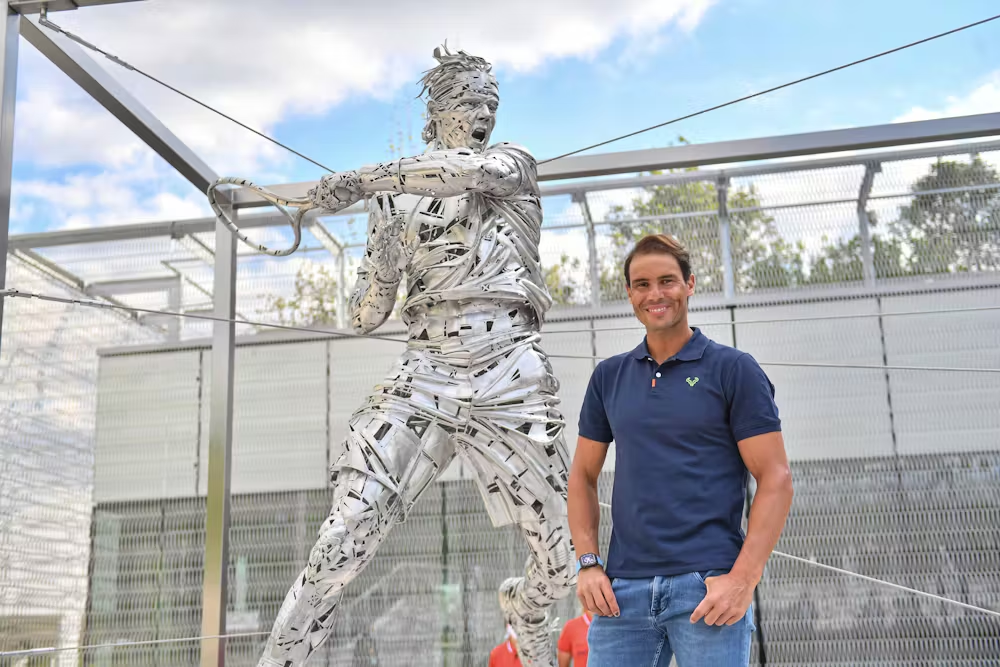
Rafael Nadal—a name synonymous with invincibility on clay courts. Yet, as the tennis legend approaches the end of his competitive career, his legacy extends far beyond his 22 Grand Slam titles. The financial empire of the “King of Clay” is equally impressive, representing a brilliant case study in how athletic fame can be transformed into a diversified and long-lasting business conglomerate.
Nadal’s financial legacy, which is conservatively estimated to be around $220–$225 million USD, is built upon three powerful pillars: prize money, lucrative endorsement deals, and visionary business investments.
1. The Foundation: Prize Money and Historical Earnings
The first and most obvious source of Nadal’s wealth is his phenomenal on-court success. Over his career, Rafael Nadal has earned approximately $134.9 million USD solely from tournament prize money. This figure positions him as one of the highest earners among all-time tennis players from competition earnings alone.
This capital served as the crucial starting point, providing him with the financial independence and liquidity necessary for subsequent, more calculated investments outside the world of tennis.
2. The Brand Empire: Endorsement Contracts
Nadal’s true financial might is revealed through his brand empire. His reputation as a humble, hardworking, and unbreakable athlete has attracted a host of global giants. His total revenue from endorsement deals throughout his career is estimated to have exceeded $400 million.
Among his most prominent partners are:
- Nike: A long-standing contract for apparel and footwear.
- Kia Motors: One of his longest and most recognizable sponsorship deals.
- Babolat: The manufacturer of his rackets.
- Richard Mille, Santander, Telefónica, Infosys, and various other global corporations.
Annually, his endorsement income is estimated at an impressive $20–$40 million, often significantly outweighing his annual prize money earnings even during peak seasons. This clearly demonstrates that his name and image are an extremely valuable asset, generating a stable cash flow regardless of his on-court performance.
3. Visionary
Investments: The Business Conglomerate
The most critical component of Nadal’s financial legacy is his capacity to diversify income streams by investing in long-term business ventures.
The Rafa Nadal Academy
This is his largest and most ambitious project. Established in 2016 in his hometown of Manacor, Mallorca, the Academy is not merely a training facility but a global educational and sports complex dedicated to developing the next generation of tennis talent.
- A Landmark Deal: In 2023, Nadal demonstrated his business acumen by selling a 44.9% stake in the Academy to the investment firm GPF Capital for a substantial sum of €94 million (Euros). This deal allowed him to monetize a significant portion of his primary asset while retaining key managerial control.
- Global Expansion: The Academy has expanded its presence, opening centers in Mexico and Greece, effectively turning a localized business into a robust international franchise.
Real Estate and Hospitality
Nadal has strategically invested in the hospitality and real estate sectors:
- Restaurant Business: He is an investor in the Spanish chain of upscale restaurants, TATEL, alongside other notable figures such as singer Enrique Iglesias and football star Cristiano Ronaldo. This venture places him firmly within the realm of entertainment and luxury lifestyle.
- Property Assets: He owns significant real estate holdings, including a luxurious villa in Playa Nueva Romana, Dominican Republic, in addition to various residential properties.
Conclusion: A Model for Financial Success
Rafael Nadal’s financial legacy is not just a monetary total; it is a sustainable business model designed to ensure stability long after he hangs up his racket. He successfully leveraged his skill on the court to build a global brand that, in turn, funds a portfolio of diversified assets.
He stands as living proof that for the modern elite athlete, the key to a true financial legacy lies not only in victories but also in strategic investment and the creation of lasting businesses focused on the development of sport and education. His wealth, like his titles, is well-earned and built on the principles of hard work and foresight.